Tradition&Heritage


Biokovo does not just tower over the Makarska Riviera; it watches it, according to generations of people who have lived in its shadow. Long before anyone built a road, let alone a glass Skywalk, this mountain was already full of legends and stories: a wedding party turned to stone, fairies weaving in the wind, and a saint who supposedly leapt clean across to the island of Brač on horseback.
What legends are associated with Biokovo?
Biokovo’s folklore centres on a handful of recurring characters and legends: a cursed bride turned to stone at Nevistina stina, mountain fairies (vile) said to live in its caves, and saints who inherited the peaks of older, pre-Christian beliefs. Most of these legends cluster around real, named places you can still hike to today — which is exactly why they have survived this long.
Nevistina stina: the bride turned to stone
One of the best-known legends on the whole mountain concerns Nevistina stina (the Bride’s Rock), a striking formation of monolithic stones near Brela on the northwestern side of Biokovo. The story goes that a young woman from the Zagora hinterland fell in love with a young man from the poorer coastal side — a match her mother refused to accept. As her wedding procession set off toward the coast, her mother is said to have cursed her: “The moment you lay eyes on the sea, may you turn to stone.” The procession reached the pass, the sea came into view, and, so the story goes, the entire wedding party turned to stone on the spot. Locals will point out shapes in the rock said to be the horses, the bride’s wind-blown veil, round loaves of bread and water flasks, and the wedding guests strung out behind them.


Geologists have their own, less romantic explanation: the rocks at Nevistina stina are monolithic limestone and flysch formations, laid down roughly 100 to 65 million years ago during the Late Cretaceous and shaped over millions of years by tectonic uplift and erosion into forms that, from certain angles, do resemble a procession of figures. Sitting at around 500 metres above sea level, the site was also once the only mountain pass connecting the coast to the Zagora hinterland, which may be exactly why a legend about crossing that divide took root here in the first place.
Nearby sits another oddity worth combining with the same walk: Šuplja stina, also known as Biokovsko oko (Biokovo’s Eye), a natural hole carved clean through the rock above Brela, framing a view straight down to the coast, as if the mountain had its own eye keeping watch over the towns below.

The fairies of Biokovo
Before it was a compelling hiking destination, Biokovo was known as a gathering place for vile — mountain fairies said to live in caves along its slopes, including named sites like Vilinska spilja (Fairy Cave) and Vilenjača. Legends describe them as beautiful young women with fair hair and eyes, but with the feet of a donkey, capable of flight, and easily offended, supposedly capable of throwing an insulting passerby off a cliff. Tradition also warned against talking about an encounter with a vila at all, since that alone was thought to invite bad luck.
One especially poetic detail survives in local memory: the “fairy loom,” a folk explanation for the sound of the bura wind whistling through the mountain’s rock formations, as though the fairies were weaving somewhere just out of sight.
Saints, snakes, dragons, and a horse leap to Brač
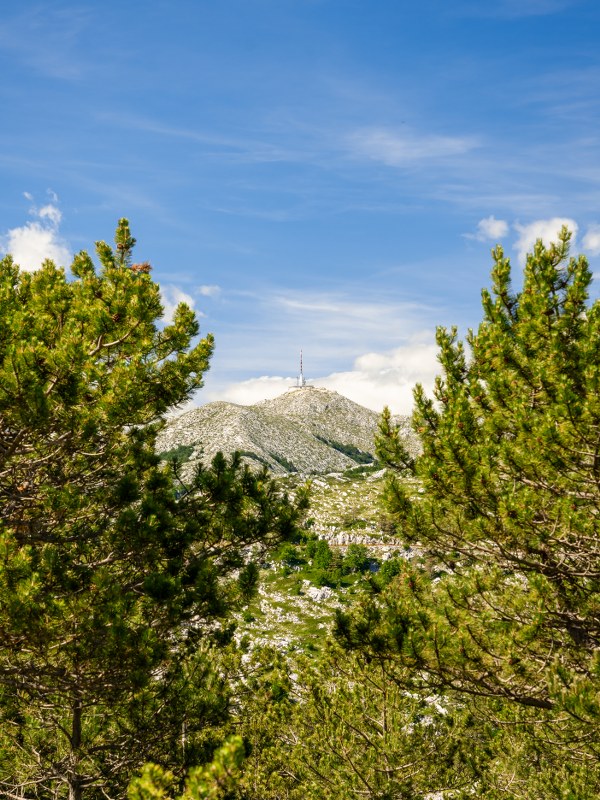
According to one historical theory (credited to historian Ivo Pilar), the Slavic settlers who first arrived in this region dedicated one Biokovo peak to a god of darkness, later Christianised as Sv. Jure (St. George), today the mountain’s highest point, and another to a god of light, later becoming Sv. Ilija (St. Elijah). Whether or not that theory holds up to modern scrutiny, both peaks carry their saints’ names to this day.
Local legends also credit Sv. Juraj with a rather dramatic feat: leaping on horseback clean across from Biokovo to Nerežišća on the island of Brač, supposedly leaving hoofprints in the rock that some claim can still be seen today. There are even more legends and stories connected to Sv. Juraj, such as the one about him being the dragon slayer.
Other legends on the mountain describe a giant snake whose call summons others to gather around it, with local advice on how to escape involves throwing an old shoe at them and running toward the sun, and werewolves said to require a stake of blackthorn through the grave to stop their return.
A road built for an empire that didn’t last
Not every Biokovo story is folklore. The Francuska cesta (French Road) above Brela is a real historical project, begun around 1808 during Napoleon’s brief rule over Dalmatia and designed by local engineer Frane Zavoreo, intended to connect Brela over the Nevista pass to Zagvozd, Grabovac and Raščani inland. Construction stopped in 1813 when the French withdrew from Dalmatia, leaving behind a road, and a pass, that share their name with the very legend of the petrified bride.
Whether it is a cursed bride, a mountain fairy, or a saint clearing an entire strait on horseback, Biokovo has never needed much convincing to feel larger than life. Walk the trail to Nevistina stina, look through Biokovo’s Eye, and decide for yourself which version of these legends — the geologist’s or the grandmother’s — you’d rather believe.