Landscapes&Beaches


Most botanical gardens are curated collections, plants gathered from elsewhere and arranged for visitors. The Kotišina Botanical Garden, tucked into the slopes above Makarska, works the opposite way. Nothing here was imported. It is Biokovo itself, fenced off and left almost entirely alone, with a ruined 17th-century fortress standing guard over the whole thing.
What is the Kotišina Botanical Garden?
The Kotišina Botanical Garden sits on the coastal slopes of Biokovo above the village of Kotišina, at an altitude of 350 to 500 metres, and forms part of Biokovo Nature Park. It was established by decision of the Makarska municipal assembly on 2 October 1984, following two scientific conferences on the Biokovo region, and is legally protected as a monument of landscape architecture. Unlike a conventional botanical garden, it was designed as an enclosed piece of real nature, preserving the mountain’s natural vegetation exactly as it grows, rather than arranging species according to a planner’s layout.
The friar who built “Biokovo in miniature”
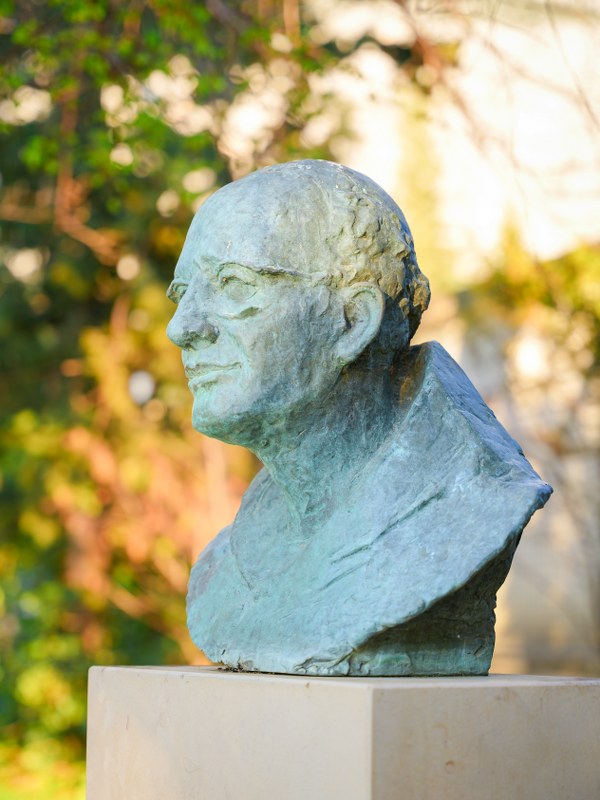
Behind the Kotišina botanical garden is one person: Dr. Fra Jure Radić (1920 to 1990), a Franciscan priest and scientist with an unusually wide reach. He also founded and ran the Malacological Museum and the Institute “Planina i more” (Mountains and Sea) in Makarska, edited several scientific journals, and is considered the person most responsible for the founding of Biokovo Nature Park itself, of which this garden is now a part. His idea for Kotišina was to create what has been described as “Biokovo in miniature,” a small area where the mountain’s different habitats could be studied, protected and shown to visitors all at once. At the garden’s main entrance, his memory is carved directly into the rock.
A garden built from cliffs, scree and one dry waterfall
The garden covers a modest 16.5 hectares, but packs in a surprising range of terrain: rocky ground, scree slopes, sheer cliffs, and small patches of arable land, all within the same enclosed stretch of mountainside. Its most theatrical feature is the Proslap canyon, home to a waterfall of the same name that stays dry for most of the year and only comes alive during heavy rain, turning a quiet ravine into a rushing stream for a few dramatic hours at a time.
Around 300 native plant species have been recorded here, ranging from typically Mediterranean plants near the coast to mountain species higher up the slope, alongside some planted exotic, agricultural and medicinal plants in designated areas. One small but memorable resident is the Neapolitan cyclamen, which flowers white or pale pink in early autumn, then disappears completely above ground through the summer, surviving heat and drought as an underground tuber before reappearing among the loose stones of the scree. The garden is at its most colourful in spring and early summer, though something is usually blooming somewhere along its paths in every season.
Walking through it
Several marked trails run through the garden, lined with educational panels and labels identifying plant families as you go, making it easy to wander without a guide and still come away having learned something specific about what is actually growing around you.
The fortress hiding inside the garden
Right beside the garden entrance, built into the same cliffs, stands Veliki Kaštel, a large fortress dating to the mid-17th century, constructed during the Candian War as protection against Ottoman raids. It remained in use into the late 19th century, later sheltering shepherds and travelling herders passing through the area, before Italian forces set it alight during the Second World War and a major 1962 earthquake finished the damage. It stood in ruins for decades until a full restoration was completed in 2019, and in November 2020 it reopened to the public as a modern, multimedia interpretation centre spread across six floors, telling the area’s archaeological, ethnological and natural history in one building.
A name that means “cauldron of silence”
The village of Kotišina is first documented in 1434, though archaeological finds in the area point to roughly five thousand years of continuous settlement here, long before that written record. Local tradition holds that the name itself comes from “kotao tišine,” a cauldron of silence, and anyone who visits when no one else is around will understand exactly why. Wrapped in cliffs on nearly every side, the place genuinely seems to trap quiet inside it.
Kotišina was never meant to impress with rare imports or manicured beds. Its entire point is that nothing here had to be brought in from anywhere else, just fenced off, protected, and left to keep doing what Biokovo has always done on its own.