Food&Wine

Every region of Dalmatia guards its desserts the way it guards its family recipes — fiercely, and usually with a story attached. On the Makarska Riviera, that means almonds toasted into candy, dough fried until it crackles, and a whole shelf of desserts that show up at every wedding, christening, and Christmas table without anyone ever quite agreeing on the “correct” recipe.
What are the traditional desserts of the Makarska Riviera?
The Riviera’s desserts table usually includes sugared almonds, a Dalmatian version of the classic filled doughnut, and two very different kinds of fried dough: crescent-shaped rafioli with a rich filling, and paper-thin, sugar-dusted kroštule. None of these desserts follow a single fixed recipe — every family, and often every town, has its own version, and locals will happily argue about whose is best. But there’s more, so read on!
SUGARED ALMONDS
Sugared almonds: a wedding tradition older than Dalmatia itself
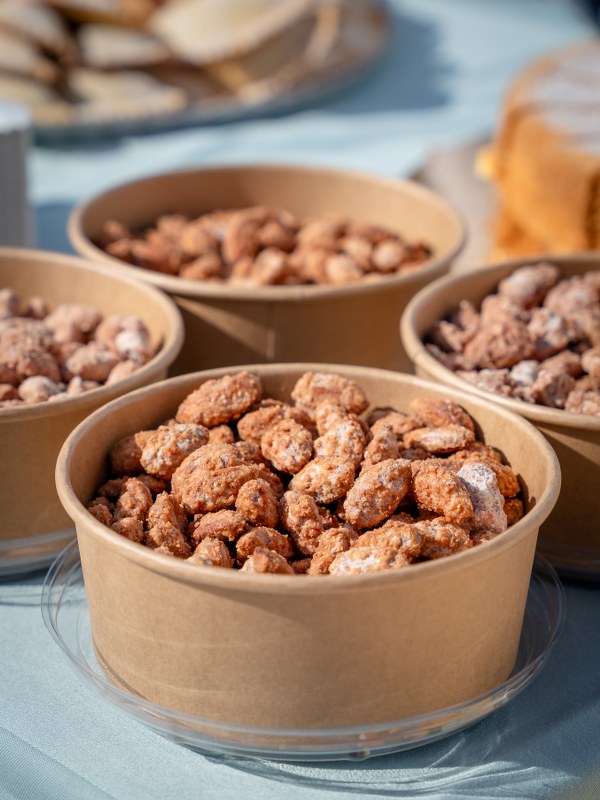
Long before they were a festive snack, sugared almonds were a wedding gift. The custom is said to go back to the ancient Romans, who gave candied almonds to newlyweds — and the tradition has never really left. Local custom calls for gifting exactly five sugared almonds to a couple, each one standing in for a wish: health, happiness, fertility, wealth and longevity. Made from little more than almonds, sugar and water, slowly caramelised in a wide pan until every almond is coated in a hard, glossy shell, they show up constantly around Christmas, weddings and christenings across the Riviera — a tiny, crunchy way of wishing someone well.
DOUGHNUTS
The Dalmatian doughnut: a market-day classic
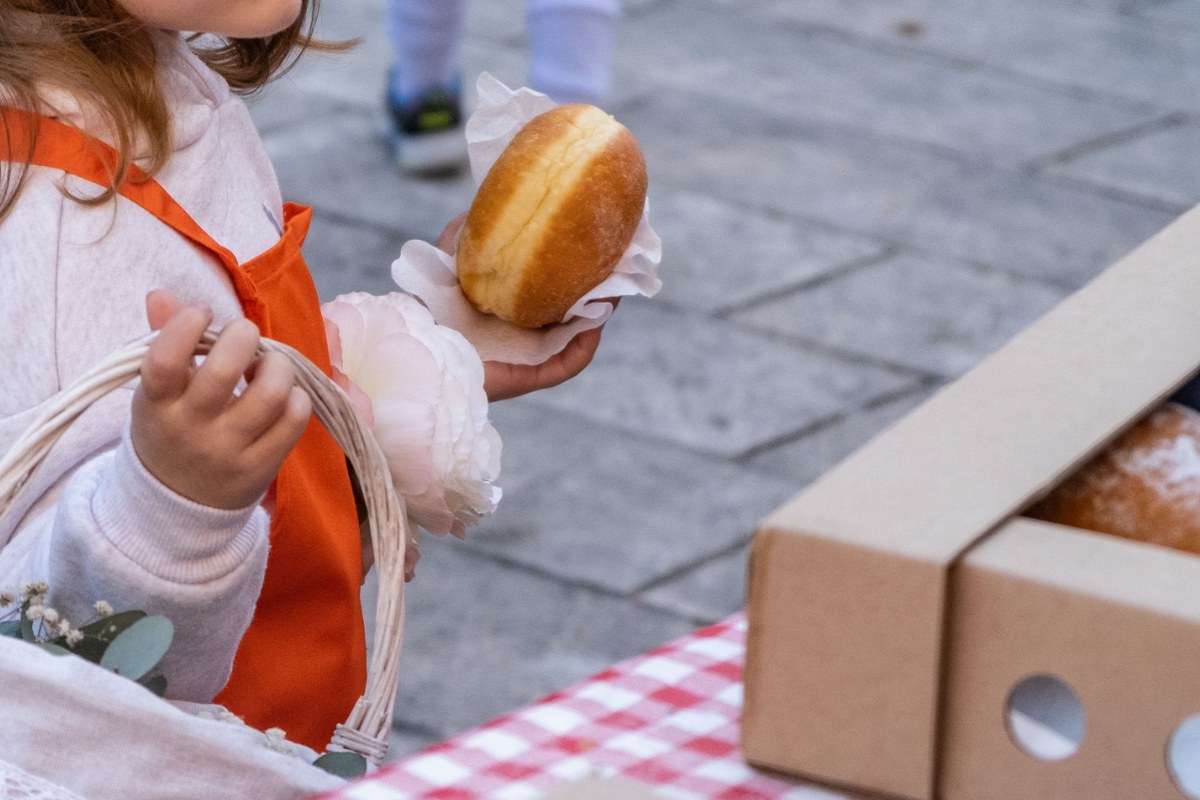
Round, golden and often dusted or filled, the Dalmatian doughnut is a close cousin of the Central European krapfen, generally considered one of the earliest European-style doughnuts. On the Riviera it shows up wherever people gather: market stalls, town squares, a basket carried by a child weaving through a crowd. It is one of those desserts nobody plans to eat, and then somehow everybody does.
RAFIOLI
Rafioli: Dalmatia’s crescent-shaped treasure
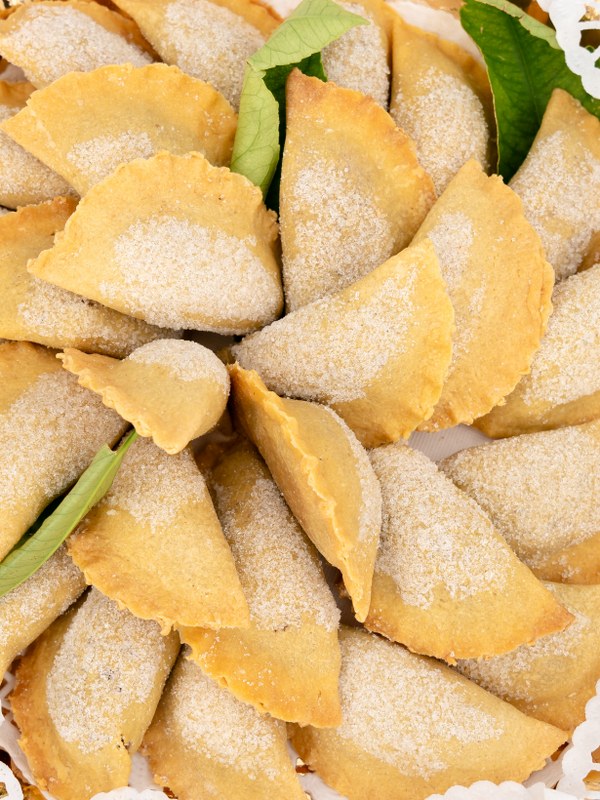
Few Dalmatian desserts carry as much local pride as rafioli: crescent or shell-shaped pastries with a rich, usually almond-based filling, so tied to regional identity that the skill of making them was declared part of Croatia’s intangible cultural heritage.
Their roots reach back to the late Middle Ages, with written recipes appearing as early as the 15th and 16th centuries, part of a wider Mediterranean family of filled pastries that also includes Sicilian and Genoese versions. On the Croatian coast, though, every town made the recipe its own: Trogir’s rafioli lean on almonds, Imotski’s use walnuts, Sinj adds chocolate, Korčula’s version (called klašuni) brings in orange, and the Riviera has its own local take too. Ask five grandmothers for “the” rafioli recipe, and you will get five confident, completely different answers — all of them correct.
Make your own Dalmatian rafioli
| Dough | Flour 500 g, vanilla sugar 1 sachet, lemon sugar (or grated lemon zest) 1 sachet, a pinch of salt, butter 140 g, 2 eggs, 1 egg yolk, sour cream 1–2 tbsp |
| Filling | Ground blanched almonds 200 g, sugar 100 g, 1 egg, sour cherry jam 200 g, almond or fruit liqueur (maraschino) 2 tbsp, plus egg white for brushing and coarse sugar for sprinkling |
1. Mix the flour with the vanilla sugar, lemon sugar and salt. Add the softened butter, eggs and egg yolk, then work in the sour cream until you have a smooth, elastic dough. Wrap and chill for about an hour.
2. For the filling, combine the ground almonds, sugar, egg, cherry jam and liqueur, then fold in a lightly beaten egg white.
3. Roll the dough out thinly and cut large circles, roughly 10 cm across.
4. Place a small spoonful of filling in the centre of each circle. Brush the edges with egg white, fold over into a half-moon, and press the edges together, decorating with a fork.
5. Arrange on a lined baking tray, brush the tops with egg white, and sprinkle with coarse sugar.
6. Bake at 170°C for around 20 minutes — rafioli should stay pale, not golden brown.
7. As soon as they come out of the oven, lightly spray or brush them with liqueur, then let them cool completely before serving.
KROŠTULE
Kroštule: the sound of Dalmatia’s carnival season
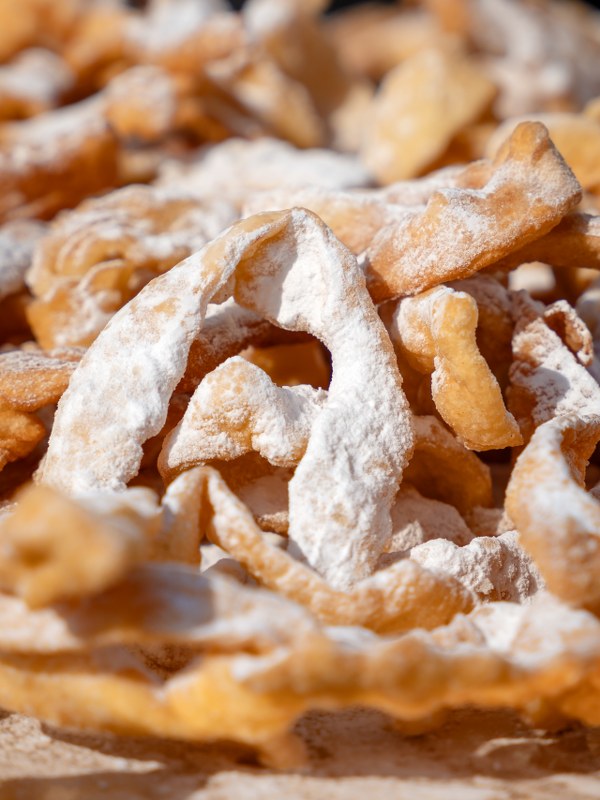
If rafioli are Dalmatia’s quiet, patient dessert, kroštule are its noisy one: thin, twisted ribbons of fried dough that shatter into crumbs the moment you bite into them. Made from little more than flour, eggs and sugar, their real character comes from what gets added to the dough: a splash of local liqueur or spirit, rakija, maraskino, even a spoonful of wine vinegar on some islands, that keeps them light and stops them turning greasy in the hot oil. Dusted with powdered sugar while still warm, they are as much a part of Dalmatia’s carnival season as any parade, and a dessert that, unlike most fried things, actually improves by sitting in a tin for a day or two.
MANDULET
Mandulet: the karst’s sweet side
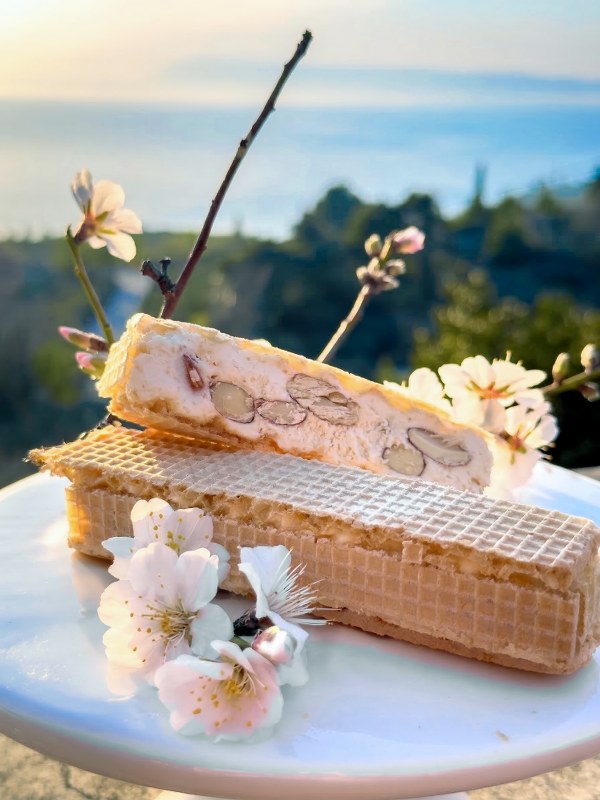
If the karst has a sweet side, it’s mandulet. This classic almond nougat is a tribute to the hardy almond trees that grow along the lower slopes of Biokovo, above Makarska, Baška Voda and Brela. It is made the slow way: thirty minutes of nonstop whisking over steam produces a light, airy mixture of egg whites, honey and toasted almonds, pressed between thin wafers until it sets. The result is crunchy on the outside and honey-sweet within, a fixture at celebrations across every village on the Riviera, from Podgora to Drvenik.
MAKARANA
Torta Makarana: the almond cake with a royal legend
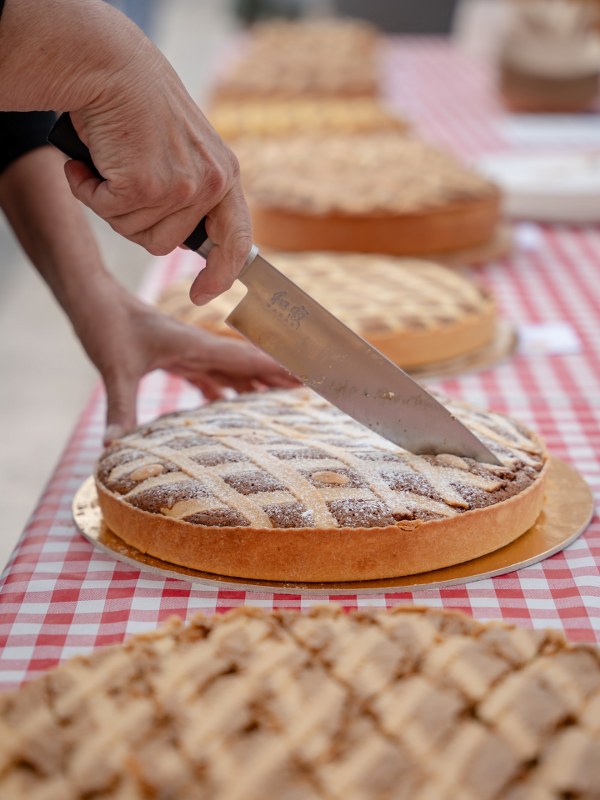
No Riviera dessert table is complete without torta Makarana, the region’s signature almond cake: a flourless filling of ground almonds, eggs, sugar, orange and lemon zest and a splash of maraschino liqueur, baked in a thin buttery pastry shell and cut into diamond-shaped slices.
Local legend traces its name to a 19th-century Saxon king who, delighted by the strange, diamond-cut dessert served to him on a trip up Biokovo, is said to have declared, “Let it be called Makarana”. The cake’s cultural weight is not just folklore, either: in 2012, Croatia’s Ministry of Culture formally declared the skill of making it part of the country’s intangible cultural heritage. Historically a winter and festive cake, made only when fresh oranges were in season, it remains a fiercely guarded family recipe.
So, which of these desserts do you want to try first?
Between a wedding almond, a market doughnut, a crescent of rafioli and a crackling handful of kroštule, the Makarska Riviera has never needed elaborate desserts to make an occasion feel special — just good almonds, patient hands, and a recipe passed down by someone who refused to write it down properly.